
“Heart valve disease can cause blood to flow backwards, placing strain on both the heart and lungs.”
Mon / Fri 7:30 am - 7 pm | Sat 9 am - 4 pm
Mon / Fri 7:30 am - 7 pm | Sat 9 am - 4 pm
In humans, as I’m sure you know, heart disease is a huge health problem causing suffering to billions across the globe. In many countries, the commonest problem is coronary heart disease. This is where the arteries supplying blood to the heart get clogged – often due to poor lifestyle choices.
Heart disease is a big issue in the pet world, too. But in dogs and cats, the problem is not coronary heart disease due to too many chips and burgers. The commonest heart conditions we see are heart valve and heart muscle disease.
This blog concentrates on heart valve disease, and here is my blog on heart muscle disease.
“Heart valve disease can cause blood to flow backwards, placing strain on both the heart and lungs.”
Ok, so here’s a problem I see most days on my travels as a Sydney mobile vet. The phone call usually starts something like this…
“Our little terrier, Missy, has been coughing for a few weeks, and sometimes she’s retching like she’s got something in her throat. She doesn’t seem her old self – she doesn’t want to go for long walks anymore.”
These clinical signs could be due to many different diseases, but heart valve disease would be high on the list. If I find a heart murmur when I listen to ‘Missy’s’ chest, there is a chance I’ve found the cause of the problem.
In patients like ‘Missy’, one of the valves deep inside the heart starts to shrivel up as part of the ageing process. We don’t know why this happens – but it’s not caused by diet or lifestyle.
As the valve shrivels, it starts to leak. Each time the heart pumps, some of the blood returns to the lungs, where it came from, rather than going forward into the body.
This means:
1. The heart has to work harder to get the same amount of blood around the body, which strains and damages it
2. The lungs get overloaded and can’t work so well
3. As the heart enlarges, it presses on the airways, so your pet feels like he has something in his throat
Some breeds of dog are more likely to suffer from heart valve disease than others. In general, small dogs like terriers are affected more. Cavalier King Charles Spaniels are at particularly high risk and can get this problem at a very young age.
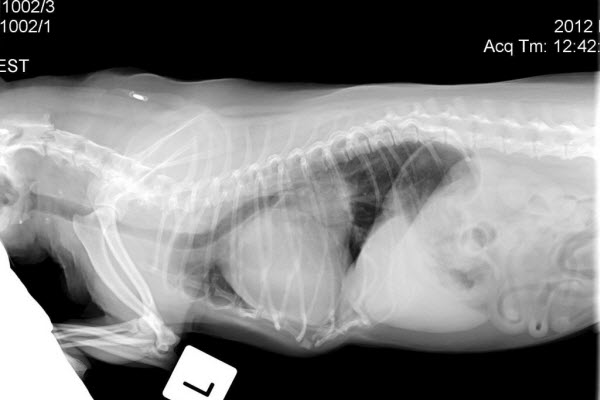
If we suspect heart disease, we often need to arrange chest X-rays and blood tests to make sure the diagnosis is correct and rule out other problems.
We can’t fix the underlying valve problem, but we can make a big difference to your pet’s clinical problems and prolong a good quality of life using daily medications.
In many cases, we use diuretics to dry out the lungs, and other specialised drugs to reduce the strain on the heart and slow the progression of the disease. We also explain how best to exercise your dog to help manage the problem.
In many cases, a combination of lifestyle management and drugs has stabilised my patients for years so they can continue to enjoy a great quality of life.
“With appropriate medication and monitoring, many dogs maintain a good quality of life for extended periods.”
Connie, a 14-year-old Chihuahua, had a cough for quite a while, but her owners were too scared to do X-rays and investigate.
2 years ago, they finally got up the courage to have a look. We took chest X-rays, and lo and behold, I found the biggest heart I’d ever seen, and I’m not just describing her soul!
The X-rays also showed some fluid in the lungs. Connie was in heart failure. So we immediately started her on a carefully prescribed mix of medicines, including diuretics and two medications that improve heart function and later inhaled steroid puffers to help her airway function.
Because her heart disease was so advanced, I expected the tables to give her perhaps a few months of extended life… but two years later, and she still barks when I arrive at the house and definitely lets me know who is in charge!
Sometimes I think Connie will keep going forever! She is very fortunate to have her very dedicated family provide her with the full cocktail of medicines.
Most dogs in heart failure like this would not have lived so long – she really is the wonder dog!
In-home care forms the foundation of how we treat and manage your pet’s health. Most conditions can be assessed, treated, and monitored in a familiar environment where pets are calmer and easier to handle. Available to residents of Sydney’s inner city, Inner West, Eastern Suburbs and the Lower North Shore.


First visit from Ari and Ellie and it went beyond all expectations. They were so genuinely interested in my two cats. Of course I couldn’t stop talking about them but they clearly were not bored. Did excellent health checks and vaccinations – was an absolute pleasure and I would totally recommend them to anybody. So fabulous having no stress of lugging…
Elle’s exceptionally professional, warm, and helpful phone manner, together with Dr Ari’s prompt arrival, gentle approach with Hudson, and clear, thorough medical explanations and recommendations, immediately put my mind at ease. The high level of care and professionalism demonstrated confirmed that contacting VETaround was the right decision.
Ari is the best vet ever. His home visits are incredible. Such a great service to not have to put your beloved pets in the stressful situation of a car. Or around sick pets in a waiting area. My cats LOVE HIM. Ollie my male cat NEVER comes out of hiding when visitors come over. With Ari, he not only came out, let him weigh him, have his check up done…
I was very pleased with the ladies from VETaround Mobile vet. Professional, polite and very knowledgeable. Certainly eased my mind about my cat 🐈 would recommend them to anyone needing good veterinary care for their pet. We all know just how important our four legged friends are!
Common signs of heart valve disease in dogs include a persistent cough, reduced interest in exercise and occasional retching. These symptoms may develop gradually and are often first noticed during daily activities. A heart murmur may also be detected during examination.
When a heart valve deteriorates, blood flows back toward the lungs instead of moving forward through the body. This can lead to fluid build-up in the lungs and pressure on the airways. The result is a cough that may seem like something is stuck in the throat.
Smaller breeds, particularly terriers and Cavalier King Charles Spaniels, are more commonly affected. The condition is also associated with ageing. It can develop even when diet and lifestyle are appropriate.
Diagnosis typically involves a clinical examination, during which a heart murmur may be detected. Chest x-rays and blood tests are then used to confirm the diagnosis and assess the extent of the condition. These tests also help rule out other possible causes of symptoms.
While the underlying valve damage cannot be reversed, treatment can manage the symptoms. Medications are used to reduce fluid build-up and ease the workload on the heart. Exercise management also plays a role in supporting the dog’s condition.
Many dogs can live for extended periods with appropriate management and medication. The progression of the disease varies between individuals. Early diagnosis and consistent care are important in maintaining quality of life.


